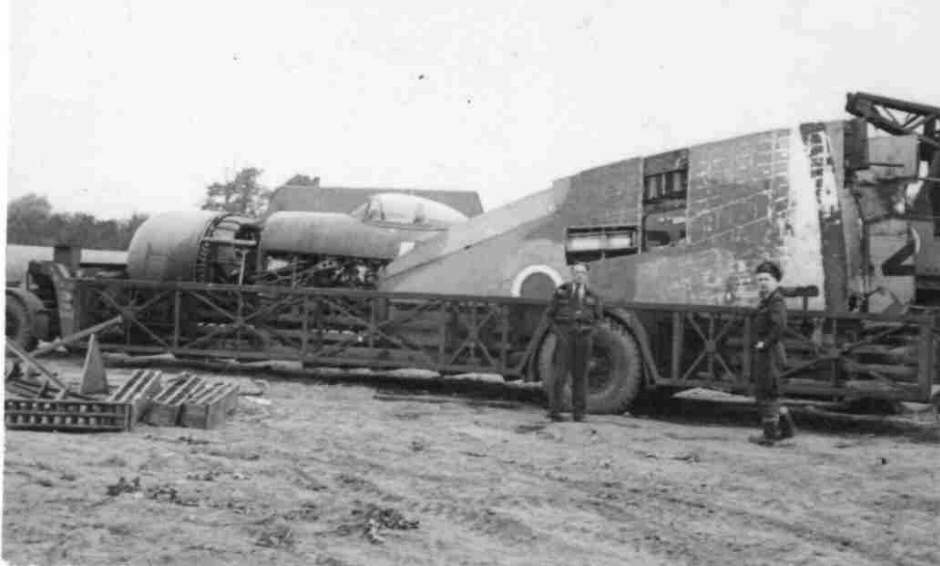
Queen Mary Transporter
Biography of David Newton Searle-Baker
Ex Aircraft Apprentice, No. 1 School of Technical Training, Halton. Buckinghamshire. England. 46th Entry, Service as a Fitter II Airframes, in the Middle East and Western Europe, Royal Air Force, 1943 – 1950
Copyright David Newton Searle-Baker 1st. January, 2000. All rights reserved. No part of this publication may be produced, stored in a retrieval system or transmitted in any form, or by any means, electronic, mechanical, or photcopying, recording. or otherwise, without the prior consent of the publisher.
Chapter 4
1945 - 1946
There has never been any conflict in my mind with regards to the necessity of the use of the two atomic weapons. Everyone that I ever met at the time was convinced that the Allies would have to invade Japan, with the consequent loss of life that this would entail, against such a determined, ruthless foe. The casualties would have run into millions as the Japanese could be expected to defend their homeland to the last.
So, it was a tremendous relief to everyone, when we heard that such an invasion would no longer be necessary, as they had surrendered!
When we passed out from Halton our pay had been increased up to the normal remuneration for our rank. Owing to this I was now getting the princely sum of four shillings (20 p) a day, which went much further than one would imagine. This was mainly because it was used to buy additional food in the local cafes, along with beer!
Very shortly after the end of the war I was sent on embarkation leave; prior to my being posted abroad. Having been unable to spend much time with my father over the years, apart from the odd occasions when our leaves coincided. It was decided that I should spend a few days with him at Peterborough, where he was serving on a flying training school
I don't think that it was easy for either of us during the short time that we spent together. Apart from the usual age differential between father and son, there was also the difference in rank to be considered, which didn't make for an easy conversation. In addition, we were nearly strangers, having been separated. during some of my most formative years!
The day after I arrived at Peterborough, father was due to fly over to a satellite base to inspect their medical facilities. Accordingly I flew with him to Sutton Bridge, which was a very isolated station in Lincolnshire, on the Wash Estuary. No sooner had we landed than he was advised that there had been an aircraft crash not five miles from the base.
It turned out that a Fleet Air Arm " Avenger " had made an emergency landing on the mud flats, but disintegrated upon hitting the ground. In that flat countryside one could see the site from a distance as the parachute had deployed, idly flapping in the wind. But the mud was deep and it took us some considerable time to reach the site, which was surrounded with the smell of death that always accompanies such a scene. Absolutely nothing that could have been done for the pilot though, other than to wrap him in his parachute, place him on a stretcher and return to the base.
All to soon the leave came to an end and I reported to Morecambe, where there was a transit camp. Here we were fitted out for overseas service, being vaccinated against some of the dreaded diseases that one could catch in the far-flung reaches of the Empire.
Then it was down to Southampton to board the " S.S.Strathnaver". Never having seen a vessel of that size before, I was suitably impressed. But my ardour cooled somewhat when I saw where we would be living for the duration of our trip. Travelling on His Majesty's Service was by no means luxurious. Our mess deck was deep within the bowels of the ship. I swear that it was almost on top of the propeller shafts! During the day tables were lowered from the overhead bulkhead. But at night these were raised and hammocks were slung! Sleeping in a hammock is an acquired art that takes time to learn. Whilst you are in the process of getting the knack, it can cause much laughter and merriment for any onlookers as you struggle to get settled for the night.
Apart from the usual boat drills, inspections, physical training etc. there was not much to do other than play cards, and enjoy the sea voyage Just as we were getting used to the new routine we arrived at our destination, Port Said.
Bum boats, naked boys diving for coins. Many offers from persons who apparently, wanted to sell their sisters, who we were assured, had just bathed, as they were very clean?
Not long before we were on our way by train, to the transit camp just outside Cairo. Here we were destined to remain, under canvas, for some three weeks whilst postings were arranged.
Day trips into the hustle and bustle of the City with all the strange sights, sounds, and smells of the East.. The latter by the way were extremely powerful, with the constant blaring of the cacophony of Egyptian music. Fine for the first half-hour but gets a bit much as the day wears on!
Photo to Come
Ismalia. Egypt. 1946
Like everyone, who visits Cairo, I took the opportunity to visit the Great Pyramid, taking a guided trip up into the King's Chamber. What fantastic achievements they are, even in the centre one could feel the air coming through ventilation ducts, that had been installed when they were built. No wonder that each generation has marvelled at their construction. One can fully appreciate why they are judged to be one of the Seven Wonders of the Ancient World. Additional visits to the Cairo Museum, but quite a number of the exhibits had been transferred out of harms way. But it was still extremely interested to see these reminders of that long dead civilisation.
In those days, as now I suspect, there were only two classes of people in Egypt. Those who were rich, in which case they were very rich, And those who were poor, in which case they were desperately poor, according to Western eyes. The more things change, the more they stay the same!
Photo to Come
Alexandria 1946
David on a Spitfire.
I was fortunate that my first posting was to the Eastern Mediterranean Communication Flight, located at Alexandria. With the constant coming and going of staff officers, we were kept quite busy. On occasions, our aircraft flew with their own ground crew, when it was known that the visit was going to be extensive. Hence, I was able to get around from time to time. One week we would be in the Western Desert, the next we would be in Palestine.
It was whilst I was on such a trip that I extended my stay by taking leave in Jerusalem and visited the Holy Sepulchre. Bethlehem, and walked the Stations of the Cross Not to mention, the Blue Mosque, the Wailing Wall, and a quick trip down to the Dead Sea.
But it was at the start of the terrorist campaign with aircraft being blown up at Lydda. British troops were being kidnapped and murdered, not to mention the various bombings.
Very shortly after this trip I was transferred to a Mosquito Wing down on the Suez Canal, just where it joins the Bitter Lakes. The nearest town of any size being Ismalia, where my photograph was taken by a street vendor. Please find attached.
It was whilst I was stationed here that I re-discovered my competitive swimming. Going on to become the Middle Eastern Champion for 100 and 200-yard freestyle, backstroke and diving competitions.
Routine servicing for a few months once again before I was re-posted to Cyprus with the Wing. Many happy memories of my stay at Nicosia, the capitals of this beautiful island. No troubles there, in those days. We worked from about 5 a.m. to 2 p.m., when we weren't on late duty Every day there was a truck laid on to take us up through the mountains, with a ruined Crusader Castle on the right. Down to the fishing village of Kyrenia., where we swam and lazed the afternoon away before returning to camp. In the evenings, when we were in funds, we could go into Nicosia for a steak and chips. It was here that I discovered the Cypriot Brandy, a delicious tipple and only 2/6 (13 p) a bottle, in those days.
During this period I once again applied for Aircrew Duties, only to be turned down once again, because they still had far to many trained personnel. Whilst reading the notice board one day, I saw that they were asking for applications from people to apply for commissions in the R.A.F.Regiment. My application was in forth-with, but it was several weeks before I had a reply. Went over to Cairo for an interview and in due course learnt that I had been accepted for training.
I returned to the UK on the " S.S. Otranto " in the autumn of '46, having been away just about a year During that period many things had happened. My father, at the age of fifty-three, had been demobilised some six month's earlier. With millions of others he set about trying to re-build his shattered civilian life. But it wasn't easy as doctors who had stayed at home were very settled in their practices and didn't like the idea of father taking their patients In the end he had set up his plate and started practising from scratch again in the Euston Road.
Unfortunately, in those early years business was slack. When he approached his old pre-war patients they said that since he went away they had been looked after Dr. So and So, going to him all through the war. Consequently, they didn't feel that they could leave him now!
However, all was not lost as he managed to get a part time position as Chairman of an RAF Board that sat dealing with the medical aspect of Pensions, which certainly helped to supplement his income..
In addition, he started writing medical articles for the national newspapers, eventually being invited to become a member of the Press Club in Fleet Street.
The Royal Air Force Regiment had been formed round about 1943, when it became apparent that airfields needed protection from infiltration by saboteurs, and others intent on blowing up their aircraft. After all, look at what the Long Range Desert Groups and Special Air Service had achieved, with very little in the way of men or equipment.
The ending of the war however, brought about an expansionist phase for this elite corps, as more and more, Nationalistic Political Parties started blowing up aircraft on the tarmac, as they fought for political control of the country concerned. So it became essential that airfields were properly guarded against terrorist activities and the RAF Regiment got the job.
The Depot for the R.A.F. Regiment was, and still is so far as I know, at Catterick, which is way up on the Yorkshire Moors. This is a bleak and desolate spot, as generations of soldiers will tell you. The OCTU (Officer Cadet Training Unit) consisted of a nine-month infantry officer's course.
The OCTU (Officer Cadet Training Unit) consisted of a nine-month infantry officer's course and some eighty-seven eager cadets arrived that September day. As with any elite corps, we never seemed to stop running, saluting, marching, drilling, polishing and burnishing everything in sight, for the first few weeks.
How I blessed my Apprentice Years, because this was just like coming home. Normally, there was about fifteen minutes between being dismissed from one parade and being inspected for the next in a totally different and spotless uniform. Any defects in your turn out being immediately rewarded with "Defaulters". This usually consisted of a particularly gruelling additional drill in full battle order at the end of the day.
After this period of square bashing, we passed on to other things. In addition to weapons training of all the infantry hardware then in use, we were instructed in such things as tactics, man management, organisation and administration and military law.
The physical side was not neglected with physical training being carried out every day. In addition to a Commando Course that all had to undergo, when live ammunition was fired over our heads, a series of Route Marches had been organised. These very slowly increased in stages from five miles, until eventually we were marching up to thirty miles a day. But by this time it was February and we were in the height of winter!
As time had progressed, our numbers had decreased, with a considerable number of fellows being "returned to unit ". Consequently, there were only some twenty-five of us left by the time that February had arrived.
But what a hard winter it proved to be in that year of '46/47. It never seemed to stop snowing right through from early in December. The Great North Road was covered with ten-foot snowdrifts with traffic coming to complete halt. Occasionally, the mercury rose above freezing and the snow melted. But only to have it re-freeze the next day and form more ice beneath the next fall of snow.
With the wind whipping up the snow into our faces we embarked on our thirty-mile route march into the unknown.
We hadn't reached the fifteen-mile mark before I knew that something was wrong with my heel and I started to limp. Slowly over the next five miles the pain got worse and worse until eventually, I was forced to drop out. I forget how I made it back to camp, probably in the transport that followed such occasions to pick up stragglers?
When I arrived in the barracks I took off my boots and discovered that, due to the boots being slightly too large, a transverse cut had opened up on my heel. Next morning I was in visiting the Medical Officer who bandaged my foot and put me on light duties. It soon became apparent that I could not wear boots again and he gave me a chit that stated I must only wear shoes in future.
Whoever heard of an infantryman, who could not wear boots, I never have. They very kindly gave me about three weeks for things to improve, but when they didn't, I too was "Returned to Unit " As I had no particular unit to which I could be returned they posted me to Germany.
By the time that I caught the ferry from Harwich it was the middle of March, and the winter still hadn't abated. For four days we were stuck outside Cuxhaven in the ferry, awaiting the arrival of an icebreaker before we could go into the port. Endless games of cards, fortunately we were only playing for matches, because I lost!
Eventually we landed and I discovered that I had been posted up to Fuhlsbuttel, which was the airport for Hamburg.
Even two years after the war one could see that Cuxhaven had been absolutely devastated. This was, in part, due to the demolition carried out by the retreating Germans. And partly due to the fighting that had occurred at that time, in addition to the aerial bombardment.
As the train rattled across a snow covered northern Germany, one could see the complete and utter shambles the country had become.
Eventually we arrived at Hamburg, which proved to be another mass of ruins, having suffered some of the heaviest bombing in the war in addition to the firestorms that consumed untold thousands. Some buildings were still standing, but the majority of this great city was in ruin as far as one could see. At the time I was told that there were still some sixty thousand corpses entombed in the ruins.
In these ruins lived the troglodyte population. Half frozen, with cardboard in place of glass in their windows. Some of them endeavoured to look smart in their threadbare clothes, but others were shabby beyond description. But they all had one thing in common. They all led a very precarious existence that bordered on starvation.
Money having ceased to have any value, they seemed to live by means of a flourishing Black Market in which everything had a price, rated in Cigarettes, Coffee, Sugar or Tea. It was simply a question of survival for the civilian population. At the time there were still millions of displaced persons, from all the countries of Europe, who had been press-ganged into forced labour for the Nazis, trying to get passports and visas to return home. These fellows lived in camps whilst the authorities processed their applications, but regular paid work was few and far between.
At the same time there were still hundreds of thousands of ex Concentration Camp victims who had to be looked after and cared for. They too had to await officialdom to provide them with all the necessary documentation before they could go home.
Chaos reigned, even two years after the war. Some progress had been made through the Control Commission Germany, (a Civilian Organisation, which had been formed to provide all the basic infrastructure, food, shelter, and process of applications.). But apart from that all the country was still under Four Power Military Government.
Right at the bottom end of the scale for any supplies was the German civilian population. It being felt that, as they had been responsible for the war in the first place, their victims should receive priority in the food chain now that the war was over.
At the time, millions of ex German Prisoners of War were still being held in various camps throughout the world. Had they been released and gone home, it would have made an already chaotic situation, absolutely impossible and anarchy would have been the inevitable result.
From my point of view though, we lived in ex Luftwaffe Barracks and had our normal service food. I was now being paid about 5/- per day and with fifty free issue cigarettes being given every week I thought that I was doing quite well.
As with all Servicemen throughout the world, our lives tended to be centred on the barracks, where we had our weekly film shows. Occasional trips into town to visit some of the Service Clubs that had been set up. But it was a very unwise fellow who went exploring the city during the night with hardly any lighting; muggings and the occasional murders were commonplace.
Needless to say, excursions down to such places as " The Red Light District " were completely Out of Bounds, although I managed to make a couple of fleeting visits just to see what it was like.
The Royal Air Force was slightly different from the other two services, inasmuch as in, both the Army and the Royal Navy, you generally served the majority of your time with the same messmates. When you were transferred you went as a Ships Company or Battalion. This allowed for very strong friendships to develop amongst individuals. In the RAF however, one was posted as an individual, as and when they required someone of a certain trade. Consequently one was always making new friends, but of a more casual nature.
Summer of 1947 I was re-posted down to 139 Wing, based at Wahn, just outside Cologne. The Wing consisted of three Mosquito Squadrons Whilst the barrack room accommodation was excellent, being of just pre-war construction, they hadn't got around to concrete runways and the aircraft were still being operated from the old P.S.P. (perforated steel plate), that had been laid towards the end of the war. With no extensive hanger facilities, servicing of the aircraft was carried out under canvas field equipment.
Here I should explain that in the Royal Air Force it was customary that all aircraft should be flight tested after a major service. At the time we used to jump at the opportunity to get airborne with some of the ground crew getting extensive flying hours. But, I believe that later on it became mandatory that members of the ground crew, who had actually worked on the aircraft, were instructed to fly on air tests?
For the next six months we explored the Westphalian Plain during our off duty hours. which were enlivened with occasional visits to Dusseldorf and Bonn, very occasionally, Cologne.
It must be realised that visiting any of the larger cities was not much fun as there was absolutely nothing that one could do, other than mooch around the town staring at ruins. No shops, cinemas, restaurants or other form of entertainment was available, other than the armed services clubs to which we all flocked. That is, unless one had a girl friend, then one could go for walks and picnics and the civilian dances that were generally held at weekends. Otherwise, like troops throughout the world, we had on camp entertainment in the form of Cinema shows and made our own amusement, whatever that might be.
Photo to Come
Cologne Cathedral
At the time Berlin was under military control by the Four Powers, Great Britain, America, France and Russia, with each of them having their own specific zone of occupation. From time to time, various squadrons of the Royal Air Force were required to do Duty Squadron at Gatow, as and when required.
In August of this year my brother, Tony, was demobilised from the army, at the advanced age of twenty-four. He had the courage to follow in father's footsteps, embarking on that long course of study that eventually led to his qualification. Not an easy decision for him to make as he had been offered a permanent commission in the army.
Towards the end of the year I took the opportunity to fly down to Berlin with one of the Squadron aircraft that had been allocated this duty.
As we came into land it was possible to see the extent of the damage that had been wrought on this great city, with hardly a house standing that had not suffered damage.
It never eases to amaze me that when an emergency occurs, everything just seems to go into slow motion.. It is almost as though everything is happening so fast that the brain cannot take it all in at once, with the consequence that it slows everything down into individual frames.
Immediately we touched down the Mosquito gave a sudden lurch to starboard, the wing dropped and the tip broke off. At the same time the propeller hit the ground and folded back, and we were thrown violently against our seat belts. The starboard undercarriage had ripped away. It was most fortunate that we still had flying speed as the pilot managed to get the wing up, with the aircraft flying along on the port undercarriage only. After a hundred yards, or so, that collapsed too and we did a normal belly landing..
Had the pilot not been able to get that wing up, we would probably have cartwheeled down the runway and no doubt ended in flames.
The roof escape hatch was open in a flash. We were out and away from that aircraft in the blink of an eyelid, standing thirty yards away, waiting for the crash vehicles to arrive.
Afterwards, we discovered that our Squadron aircraft had seen service in Burma during the war. With the Mosquito being of wooden construction, combined with the climatic conditions in the Far East there had been considerable wood shrinkage taking place in the undercarriage support mountings which caused the undercarriage to rip away when we landed. Quick checks up at sick quarters and I was on my way into the centre of the city. What a cold dismal town it was, with nearly every building being a ruin and hardly any lighting once night had fallen.
Photo to Come
Hitler's Bunker
Took the opportunity to visit a number of places such as Mr. Hitler's Bunker in the garden of the Reich Chancellery, where I had the pleasure of stamping on the spot where he was supposed to have been half cremated.
Stood in the rear entrance to the bunker, but couldn't descend because it was flooded. Wandered around the Chancellery, which was covered with graffiti, in Russian, English and French.
Visited the Reichstag, the Brandenburg Gate, walked down the Unter den Linden and thought of those ghastly bodies of Germans, who had been executed for desertion during the closing stages of the war, hanging from the lamp-posts. Saw the memorial to the Franco-Prussian War, with the Russian Memorial nearby. But Berlin was just another cold, dreary, ugly, smashed city. Inhabited by ghouls and the ghosts of the past, especially at night in the Russian Zone, when armed, drunken, soldiers roamed the streets looking for women. Quite a number of allied soldiers just disappeared into the night.
For the most part the people living in Berlin, or the whole of Germany for that matter, were cheerless. People were fully occupied and exhausted by the difficulties of maintaining any simple, ordinary life in such abnormal circumstances. Just getting from place to place was a problem in itself with virtually no private cars. The S-bahn (local electric railway) ran, but that was about all, as there was hardly any other public transport.
Early in December I was posted yet again, to a Maintenance Unit at Luneburg, just outside Hamburg, where I was to be involved in carrying out major servicing and repairs to all types of aircraft. I arrived late in the afternoon of my-twenty - first birthdays. Not knowing anyone on the unit, I had little to celebrate and decided to go into Hamburg to ring my Mother and have a beer. Consumed two pints, whilst I waited over two hours to get a telephone connection, only to be told that they were unable to get through.
After some two months I was transferred from the Maintenance Unit to a Base Repair and Salvage Unit that was based on the same station. This unit went all over Western Europe collecting aircraft that had crashed and decided upon their disposal.
a) They could be repaired on site.
b) They could be dismantled and sent back to base for repair, on a Queen Mary, low loader transporter.
c) They could be scrapped.
By this time we are into 1948 and the Berlin Airlift was just getting into full swing as the Allies started airlifting supplies into the beleaguered city.
Meanwhile we had the normal scattering of accidents throughout the year. A Mosquito down just north of Hanover, a Tempest down in North Germany, a Typhoon down in Holland, a York crashing with a full load of coal on board. When it crashed the load moved forward and trapped the crew, the aircraft went up in flames and there was nothing that anyone could do to save them.
Quite a number, such as the Mosquito had the remains of the crew still trapped in the remnants of the aircraft. In this case the pilot was found half under the engine when we lifted the remains of the aircraft.
A three-week visit to Berlin to repair the tail-wheel on a Hastings, after it had collapsed and damaged the rear end of the aircraft.
On the odd occasion when we were not on a recovery detail we were pressed into service with a Graves Registration Unit. This required us to go around digging up bodies, from aircraft that had been shot down, or crashed, during the war. Not a happy job, but to console us we were given an extra sixpence per day, hard line money
One night, towards the end of January 1949, we were dragged out of bed at 3 a.m. A Dakota had come down on the approach into Lubeck. Unfortunately it had crashed in the middle of a forest, in the Russian Zone.
We were on our way by 05.00 hrs, in freezing weather with a blizzard to keep us company. Having been told that special passes were being flown up from Berlin to enable us to enter the Russian Zone, we didn't expect any difficulty. In the end it took four days before these passes arrived and we could cross the border. As soon as we did there was an armed guard of Red Army soldiers around us. It was only some seven miles to the crash site, but it was obvious when we saw the wreck that all that it was good for was scrap.
Unfortunately there had been a number of people on board and their bodies had not been removed, or even covered, in that winter weather. There they lay, or in some cases stayed impaled on broken trees, with a thin dusting of fresh snow.
Obviously the first thing to do was to remove the dead. This we proceeded to do then set about removing what was left of the aircraft. No cranes could be got into the middle of the forest, so it was manual labour and the old "Heave Ho! ", until we could get the remains of the aircraft to a farm track about a mile from the site where a crane could lift them onto a "Queen Mary ", low loader.
In the end the only way in which we could remove the wreckage was by bringing up a Heavy Duty Recovery Vehicle. This when anchored to one tree, used it's winch to extract the bits and pieces. But it was a slow and laborious business that had us all working for 72 hours non-stop. Eventually we managed to get everything away and returned to Lubeck, where we slept for twenty hours.
In the spring of '49, I applied for aircrew duties once again, only to be told that there were still no vacancies, with the Air Force being reduced, not expanded.
By June of that year, I had served my two and a half years in Germany and became due for a home posting. This duly arrived, I found myself posted to "The Empire Air Navigation School ", at Shawbury, in Shropshire.
The days passed peacefully at Shawbury. I was now in the big league, earning some eight shillings a day! But even worse, I had fallen in love, with an engagement ring being high on my list of priorities. But how to obtain the extra cash was the problem? In the end, I managed to get some employment by helping the local farmers bringing in the harvest.
With the onset of autumn it became necessary for me to get alternative employment. I was fortunate and managed to obtain a position as head dishwasher / scullion at The Galleon Restaurant, in Shrewsbury. Being paid the princely sum of one shilling and sixpence per hour. I worked as many hours as I could get. The only problem being that I had to work an hour to get my bus fare into town. ! And so it went on for the remainder of that year, and into the spring of 1950.
My dream over the years had been the usual one of a cottage in the country, with roses round the front door and a loving wife waiting to greet me when I came home from work. Amazingly simple really, but not easy to obtain when one has absolutely no cash!
Eventually I managed to save some £50; off I went to get that precious ring. Our relationship only lasted some four weeks after I had given it to her, so all my effort had been in vain. Can't say that I was exactly the best catch in the marriage market for that year.
Early in 1950 the Air Ministry had re-introduced a means whereby regular servicemen could purchase their discharge. Sometime in March, I requested that I be allowed to take advantage of this opportunity to return to civilian life, having borrowed the Hundred Pounds from my father. The request was granted, in June my release papers came though. I was given a sports jacket, grey flannel trousers, shirts, socks and a couple of pairs of shoes, along with a raincoat and a pork pie hat, but no gratuity.
Not a very exciting tale I'm afraid. Just the same sort of life that was experienced by millions of my fellow countrymen. All of my teenage years and youth had been expended during the war, and subsequent years.
I didn't know how I was going to achieve it, but I stepped out into the world at the age of twenty three, full of confidence that I would make my future, with all my worldly possessions contained in one kit bag.
How I got on, and what happened, over the next fifty years, must remain for some future epistle, as it has taken some six months to get this far.
----- David Newton Searle-Baker
Back to Prologue, or back to Chapter One, or Chapter Two or Chapter Three
Many of the stories contained in the online James F. Justin Museum of Military History are now in paperback and kindle ebook format, with more coming, check out
How We Served, by John Kenneth Justin
Also, Please help this site preserve our history, become a Patron today! Become a Patron!
LINKS
BACK TO JUSTIN ORAL HISTORY AIR FORCE BIOGRAPHIES HISTORY PAGE
Please Share your Stories! E-mail me to share or discuss or with any questions!
As an Amazon Associate I earn from qualifying purchases.
This Page and Its Contents and all original pages linked thereto Are the Property of John Justin @ Copyright 1999, 2000, 2001, 2002, 2003, 2004, 2005, 2006, 2007, 2008, 2009, 2010, 2011, 2012, 2013, 2014, 2015, 2016, 2017, 2018, 2019, 2020 All Rights Reserved
The URL of this page is
http://justinmuseum.com/jkjustin/Searlesbio3.html