Biography of Melvin M. Smith
CCCMan, Enrollee, Company 971, Alexander Flats Camp F-175, Alexander Flats, Idaho
Sailor, LST 919, Pacific, WWII, USN
I would like to give you a bit of my 6 months experience in the CCC November through April of 36-37.
I signed up for six months to carry me through the winter months, when there were so precious few jobs available during the winter around Boise Idaho area.
We were just beginning to slowly recover from the terrible depression. The recovery was certainly due in part, a very large part I feel, to F.D.R.'s programs such as the CCC which took a very large number of men from all over the nation and put them to work, mostly in the western and north western states, controlling tree infections from attacks of "blister rust", planting trees in the forestry, building roads, etc.
I lived in Emmett, Idaho near Boise where I entered the C's and spent 6 months at Alexander Flats Camp F-175 - Company 971 along the Boise River 67 miles above Boise. We worked all winter building a road on farther into the mountains to Atlanta, Idaho, a mining town - during the winter of 1936- 37.
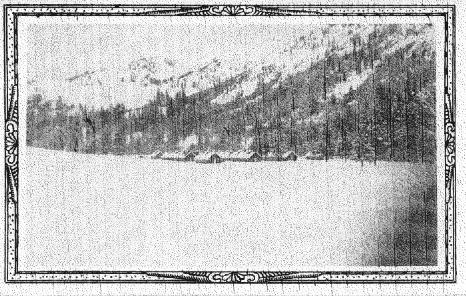
Camp F-175, Co. 971 Alexander Flats Along the Boise River 67 miles above Boise Idaho
I went to Boise only twice in that 6 months, a very cold ride of 67 miles in the open bed of a forestry truck covered only with canvas- no heat in sub-zero weather and on one such trip some time in February an avalanche had covered the road a few miles below camp and we all turned to with shovels to open an opening to allow the truck to pass through.
Needless to say, the comfort of the rec room was more inviting than the trip into town that winter.
Five feet of snow was normal for this area. The Boise River which ran near the camp becomes a white water river as the snow melts in the Spring.
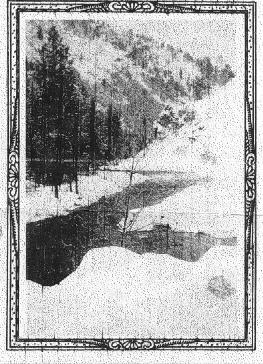
Boise River about 1/2 Mile above Alexander Flats Camp F175 CCC Camp Co 971
The area around was very scenic. Along the River one could see strings of deer and elk headed downstream daily. One could get a nice view from Buckers Point, which was on the river above the camp.

View from Buckers Point looking down river (above camp)
I took photos of the camp and nearby scenery on one of my many walks near camp, on January 10, 1937 (the photos shown on this page).
My older brother Calvin Smith, spent 2 years in the C's, coming out as an experienced cook, in May 1936.
I later worked in the mines at Atlanta, Idaho, only 20 miles up river from the Alexander Flats CCC camp (which there is no sign of its existence at all anymore) as I have driven past the site many times over the years and always felt a bit of nostalgia of my short time there. I'm now 86 years of age.
I worked as a miner and repair miner there from 1939 until 1941.
In November 1941, I signed a 12 month contract with Morrison-Knudson, one of America's larger contractors for work at Pearl Harbor, Hawaii. Their corporate headquarters were at Boise, Idaho and they were hiring workers for work on Wake Island, Guam and a number of islands in the Pacific also.
I arrived at Honolulu, T.H. December 3, 1941 and reported to M.K's job site on a Navy Reservation called Red Hill, which is above Pearl Harbor, where we were building underground fuel storage tanks in a mountain for the Navy.
I worked 3 days, Thursday, Friday, and Saturday. The 6th of December on the day shift, and since they changed shifts every 2 weeks on the 7/24 project, our day shift came off work at 4:00 PM and we went back in to work at midnight to 8 AM shift at 12:01 December 7th.
December 7th, that day of infamy, as FDR put it, we walked out of the portal of the tunnel at 7:55 AM after an 8 hour shift, welding on #1 tank in the mountain. To our shocking, unbelievable surprise one could see the Japanese planes swarming among and above Pearl Harbor below us dropping their torpedoes and bombs as well as strafing Hickam air force base just across the fence from Pearl Harbor - one could not accept it, as what we were witnessing - all around you one could hear, maneuvers!, maneuvers! In just a few minutes there was so much smoke, one could hardly make out the Harbor and/or ships burning as they were taking a pounding from the Japs.
A group, a large number of workers, walked along a road leading to our quarters less than 1/2 mile distance - stopping only to look down toward the harbor when a loud explosion occurred, one of which turned out to be the Arizona when that ship shook with a number of hits.
We continued on a way, when a Jap Zero flew, are eye level, up the Canyon below us, gaining altitude after a run on the installations I reckon, we could see the pilot plainly and the large red emblem on his plane. He could have mowed a lot of us down with a burst from his machine guns, but he chose to save the ammo for a military target I guess. Anyway it was with a sigh of relief that he sped by us. Upon reaching our quarters most of us took showers and went into our mess. hall for breakfast after a bit. And when I was about ½ finished eating when all hell broke loose down in the harbor. There must have been 200 men eating when the 2nd wave arrived and we all ran outside into the lawns surrounding the mess hall to gawk at what was happening below us.
Every gun left usable from the 1st wave was now manned by sailors marines and military personnel and they were shooting at anything flying, unfortunately one of those planes was flying right above us, so low we could read the markings on it. It was one of our own B17s or Flying Fortress as they were called, and anti-aircraft flak was bursting all around him and the shrapnel from that was falling among this crowd of onlookers like hail. I couldn't believe how that plane could continue flying with all that flak bursting around him but he put that plane in a real steep bank and flew back out to sea and was still flying the last we could see. We learned later that this was one of a group of B17s headed for Clark Air Force base in the Philippines and it was coming into Hickam for refueling.
After what seemed like an eternity, the guns silenced and the explosions stopped. The men started huddling and talking after hearing rumors that the Japs had landed soldiers at Kaneohe Bay on the East side of Oahu. A large group of men walked to the personnel office demanding rifles but during the last few hours marines had replaced the Civil Service guards on the naval reservation and marshal law had been declared for the entire island, restricting traveling. So it was a marine officer who told us there would be rifles for us when the time comes to a last ditch fight, but for now there would be some order of training and those of you who wish to participate, gather at the ball diamond. where they brought out some wooden rifles and passed them around. And told that we would be under the command of a marine.
Needless to say, there were some unhappy campers among those men working at Red Hill, these were hard rock miners from all over the Northwest - Steel Workers and Tunnel workers, who remarked, I don't want a damn stick to march around with, I want a damn rifle. Of course there were a good number of these men avid hunters and they felt they understood the use of a rifle and they felt there wasn't time enough for this 'nonsense' as they put it. If it is true the Japs have landed. So it went for the rest of Sunday, 7th of December 1941.
We did not go to work the 2nd and 3rd shifts, but December 8th men were asked for volunteers to help bury the dead, to which I helped as a volunteer. A large trench was opened by a large steam shovel not too far from Aeia Hospital where we manned shovels to "square up" the trench bottom and the flat bed trucks hauled plain wooden boxes up to the line where they were placed next to another in the mass burial site.
Dec. 9th. The Red Hill project was organized to straight day shifts for workers living off reservation, and those of us living on the naval reservation were assigned 16 hour shifts, 4:00 PM til 8:AM next day, those were some long hot shifts welding in those tanks underground!
This arrangement was due to avoiding any workers from being on the streets or by ways after dark, changing shifts at jobs, as we were now at war and blackouts are being enforced by the military.
Just let some absent minded individual walking out of a "blackout building" such as the recreation hall with a cigarette in his mouth and he would be sure to hear a marine shout put it out or I'll shoot it out.
We worked those 16 hour shifts for about 6 weeks before the management reorganized the shifts back to 3, with changing every 2 weeks as before. Day shift to grave yard shift (12 midnight till 8:00 AM) 32 hours change then coming back on swing shift, 4 PM to midnight. After working on those tanks from Dec 3, 1941 until about September 1843, our end of the work as welders was finished. So I answered the call for welders in the Navy Yard and was assigned to shop #26 where all welders worked out of, after passing welding tests for Welder 1st class. I was assigned to the sheet metal shop where I reported to work until April 1944 when I returned to the States with thought of spending my 30 day paid leave in Idaho and then joining the Navy's SRU (ship repair unit) who are made up of skilled trades such as welders, steel workers, and electricians, plumbers and so forth for duty on LSDDs which are mobile dry docks that go along with Convoys or battle groups to make repair on damaged ships enabling them to proceed to a major port for major repairs..
I went into Navy recruiters office in Boise to sign into SRU, but was advised there were dozens of men awaiting the Navy’s call for next company (120 men) to report for duty. So I volunteered for regular navy duty - went through 8 weeks "boot" at Farragut Training Center, Farragut, Idaho - on to Great Lakes Training Center for 8 weeks basic engineering school, then to Richmond, Virginia for 8 weeks diesel school, allowed six days leave before reporting to Treasure Island San Francisco, boarded a Navy Transport straight to Hollandia, New Guinea to a Navy repair base for 5 months then aboard a transport for Leyte, Philippines where I was assigned to duty aboard LST 919 one of the larger of the Amphibious ships last of April 1945.
LST 919 saw duty transporting troops and equipment to numerous islands and to Jiusu, Korea (?) until the war ended in August 1945. Afterwards it was transporting Jap prisoners of war, personnel from Tin Sin China to Sasebo, Japan, up until Christmas Eve, 1945, when I left LST 919 at the Sasebo, Japan port to return home and discharge from the Navy January 11, 1946. This about covers my experience of the World War II era.
----- Melvin Smith
LINKS
BACK TO James F. Justin Civilian Conservation Corps Museum Biographies
Also Be Sure to Visit
James F. Justin, Civilian Conservation Corps Museum
Justin Museum of Military History
Please Share your Stories! E-mail the Curator to share or discuss or with any questions!
Copyright 2004-2019 John Justin, All Rights Reserved
The URL of this site is
http://www.justinmuseum.com/oralbio/smithmmbio.html