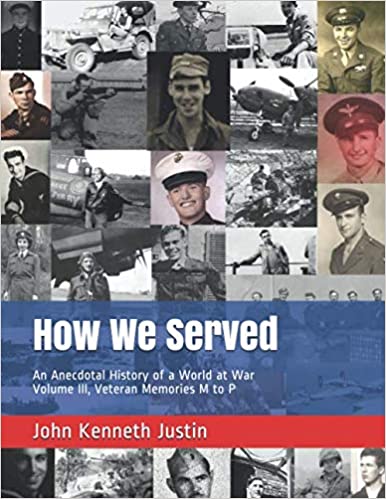
How We Served, by John Kenneth Justin
Biography of Helene (Nell) Gill
French Resistance, WWII
Helene (Nell) Gill
The following is an account of my mothers small role in assisting an American airmen to escape occupied France. I accompanied her during this period, but as a three year old have no recollection of meeting Trafford Curry or of the events that took place.
Shortly after her death, for the benefit of her grand and great grand children, I started researching my mother's activities with the French Resistance. I was soon overwhelmed with the amount of information I was able to access.
I discovered numerous web pages dealing with WW II escape lines, and volumes of now declassified files on rescued airmen and the people who assisted them. The most surprising document was a 69-page report, in diary format, handwritten in English by my mother 'Nell' during her military intelligence debriefing after the liberation of France. Cross-referencing the diary with the numerous airmen's reports and official intelligence files gave us an insight into what she did during the occupation of France. This enabled me to compile a book which I was able to give to our extended family. This is an excerpt, relating to Trafford Curry, from my book, preceded by a brief explanation of who my mother was.
On 12 May 1917, in Petrograd (now St Petersburg) amid the first Russian revolution, Elena Feodossieff, aka 'Nell', came into the world. Three months after her birth, the family home was seized by the provisional government causing the family to flee Russia, eventually settling in Paris. In 1936, 19-year-old Nell took out French citizenship. This meant her Russian name 'Elena' became the French equivalent 'Helene', but to family and friends she was still Nell. In 1937 she acquired British citizenship by her marriage to an Englishman, James Charles William Gill.
On 30 June 1940, two weeks after German occupation of Paris, internment camps were established by the Germany army. These held Allied civilians, including British and US subjects, who were captured in occupied areas. The Germans perceived these people as a potential threat.
Twenty-three-year-old Helene (Nell) Gill, her four-month-old baby Daniel, and husband James Gill were rounded up and sent to separate camps. British by birth, James was sent to La Grande Caserne, Saint-Denis, and remained there for the duration of the German occupation. Helene (Nell) Gill and her son were interned in Besançon. She was released after six weeks by pleading that she needed her mother's help to look after her infant.
The authorities imposed strict conditions on her release. She had to report daily to a gendarmerie (French police station) so the German authorities could always trace her whereabouts, she could not go outdoors after 7:00 pm, and her work permit was revoked.
In 1941, as a sojourn from the overwhelming German presence in Paris, Nell started taking annual summer holidays with Daniel in Nogent-le-Rotrou, 150 kilometres south west of Paris, where she had friends. Before taking the two-hour train journey from Paris, she had to get a permit from the German authorities allowing her to sign in daily at a local gendarmerie.
Two years later, in July 1943, Nell and three-year-old Daniel left Paris for their regular six-week summer holiday in Nogent-le-Rotrou.
On arrival, she was met by local teacher, whom she knew from previous holidays. He explained that they had been anxiously awaiting her arrival. Five days earlier, a British airman had parachuted from a stricken Halifax bomber and was given refuge in a nearby farm. The locals wanted to get him out of Nogent as quickly as possible before he was discovered by the Germans. As Nell was fluent in English, the teacher thought she could help the airman.
One of Nell's close friends in Nogent-le-Rotrou Jacqueline, worked for Sécurité Militaire, the British Intelligence service based in Paris, she made arrangements for the SIS, (Secret Intelligence Service) to send someone to take the airman, Ivor Sansum, to a small village, Mortrée, en route to an escape line. She also pleaded with Nell to accompany the airman and Carmen the SIS guide on their journey. Nell accepted, but explained she would have to take her son Daniel with her. After a hazardous and exhausting journey avoiding many German checkpoints, Sansum was delivered to the head of the local Résistance.
On the return journey, Nell told Carmen she wanted to become a useful member of the group, she urged Carmen to talk about her to the 'Chief', explaining that her knowledge of several languages (French, Russian, English, German), could also be useful. Carmen said they were very short of people, owing to the summer holidays and because many had been caught by the Gestapo. Nell and her son left the train at Nogent-le-Rotrou and Carmen continued to Paris.
Two weeks later, an excited Jacqueline returned from a meeting with her supervisor at the British Intelligence Service (Sécurité Militaire)in Paris.
She told Nell that because they had very few people at their disposal, she had been asked to take on a role of convoyeur (guide). For her first mission, she was to travel to Mortrée, where Nell and Carmen had been a few weeks earlier, to collect Ivor Sansum and the other two airmen being cared for by the local Résistance, and take them to Lyon for eventual transfer to Barcelona.
Because the airmen had no identity papers and Germans were checking documents at the major rail stations, a long and complex route from Mortrée to Lyon had been planned to avoid checkpoints. Nell expressed her concern; she thought it unwise for Jacqueline to go on her first mission with so many airmen to look after. Jacqueline agreed and asked Nell to go with them and to act as an interpreter. Nell was willing to help her friend and the airmen, but had to overcome numerous difficulties. She had to sign in daily at the local gendarmerie, she only had her British identity papers, and most importantly, she had to take her young three year old son with her.
This second unofficial mission was even more complex and dangerous than the previous one but all were delighted when the airmen reached the safe house in Lyon.
Two weeks after their return from Lyon, Jacqueline’s supervisor code named Axel interviewed Nell for four hours. He told her she had been investigated and accepted into 'the organisation'; In her role as a convoyeur (guide), she was to collect airmen from various locations, bring them to safe houses in Paris and then convey them to Lyon, which she had already done in an unofficial capacity with Jacqueline on two occasions.
Axel introduced Nell to Jeanne Huet, who had just been recruited to be a Paris 'host', sheltering airmen in her large apartment.
Forty-five-year-old Jeanne Huet was said to be one of the wealthiest women in Paris, as evidenced by her eighteen-room apartment at 48 Avenue du President Wilson. Nell was then introduced to Jacques Dupuis. He ran an insurance company in Lyon and looked after the Paris end of the escape line for Jules Carter, whom Nell had met in Lyon on her previous mission. She was to work with Jacques, bringing Allied airmen to Paris then taking them to Lyon before the final leg of their journey home. She was provided with false identification documents, which enabled her to travel all over France. As Nell would need some help, Jacques said he had an ideal person for this work – Madeleine Grador – she was energetic, full of courage and absolutely reliable. A few days later, Dupuis sent Madeleine out of Paris to collect an American airman named Trafford Curry.
Jeanne Huet had told Nell that she would like to provide shelter for Allied airmen, so Nell promised her that the first one would stay with her a few days while waiting for Julien's instructions. One Sunday morning, Nell was having a meeting in Jeanne's apartment with Axel and Jean-Pierre when Madeleine and airman Trafford Curry arrived..
As Jeanne did not speak English, Nell visited Curry regularly. He had not spoken English for three months and was pleased to be able to chat with someone. Jeanne's friend, Paule Vastel, came daily to practise her English and her dance steps with Curry. After a few weeks, when a pickup arranged by Julien Carter didn't eventuate, Curry started to get impatient, threatening to leave by himself. Nell decided to take matters into her own hands and asked Jeanne to prepare things so she could take Curry to Lyon. She telephoned Jacques Dupuis and told him about her decision. He agreed.
Taking her son Daniel with her, Nell and Curry left Jeanne's apartment, boarding the local train to the main station. Curry kept a few steps behind Nell, acting as if he was travelling alone. On the train to Lyon they had to board a first-class carriage as there was no room elsewhere. The carriage was half empty with only three men in it and as planned, Curry sat apart from Nell and her son, keeping silent. He had his own ticket and identity papers, but as they were fake Nell decided it was best not to let the Germans see them. On the journey, she met an English girlfriend who was hiding from the Germans to avoid internment. They spoke the whole night while Curry slept like a child. Nell started to get worried when the train approached Dijon, where documents were usually inspected. When the train stopped at Dijon, the carriage door was suddenly opened, and two German officers entered. They stared at everyone, saying nothing, then as they apparently didn't find what or whom they were looking for, they closed the door and left. Nell was quite shaken, but Curry slept through it all.
They arrived at Lyon at 8:00 am, then took the local train to Mr Bonnamour's “safe house”, staying with Mr and Mrs Bonnamour for lunch. Julien Carter arrived in the afternoon; he was cheerful and delighted to see Nell again.
After their meeting, Julien Carter left for Switzerland. Nell, Daniel and Curry remained in Mr Bonnamour's apartment. Next morning, Mr Bonnamour left with Curry. It was a tearful farewell and Curry was very thankful for all that had been done for him. He eventually crossed the Pyrenees with the Jules Carter Escape Line and arrived safely in the UK on 17 January1944.
Nell's first missions were with the group conveying airmen to John Carter, aka Julien, or Jules Carter in Lyon. Until the Germans took over what was the unoccupied zone in November 1942, it was possible, weather permitting, to travel across the Pyrenees mainly by foot, into Spain. This was the escape route operated by Jules Carter.
Airmen were guided to Lyon, usually from Paris, then taken by other guides on the hazardous journey across the Pyrenees to Spain.
Nell was of the opinion that being 'obvious' made her less suspicious; also, the sight of a woman with a child was usually disarming, so German soldiers and the Vichy police, who were Nazi sympathisers, would not question her. She once said, 'I always took Daniel along. Germans like children and his presence made my lot easier. They never suspected that a woman travelling with a child would be an underground agent.'
At the conclusion of the war Nell received several awards from British, French and American governments, including a Citation from the President of the United States of America,and the US medal of Freedom
Any information about his company, camp or service would be appreciated.
----- Dan Gill
Email: dan_gill AT me.com
Copy the above into your mail address window and replace spaceATspace with @
This is to avoid spam mailing.
Many of the stories contained in the online James F. Justin Museum of Military History are now in paperback and kindle ebook format, with more coming, check out
How We Served, by John Kenneth Justin
Also, Please help this site preserve our history, become a Patron today. Become a Patron!
LINKS
BACK TO JUSTIN ORAL HISTORY ARMY BIOGRAPHIES HISTORY PAGE
Also Be Sure to Visit
James F. Justin, Civilian Conservation Corps Museum
Justin Museum of Military History
Please Share your Stories! E-mail the Curator to share or discuss or with any questions!
As an Amazon Associate I earn from qualifying purchases.
The URL of this page is below
http://www.justinmuseum.com/oralbio/gillhelenenellbio.html
Copyright 2020 John Justin, All Rights Reserved